
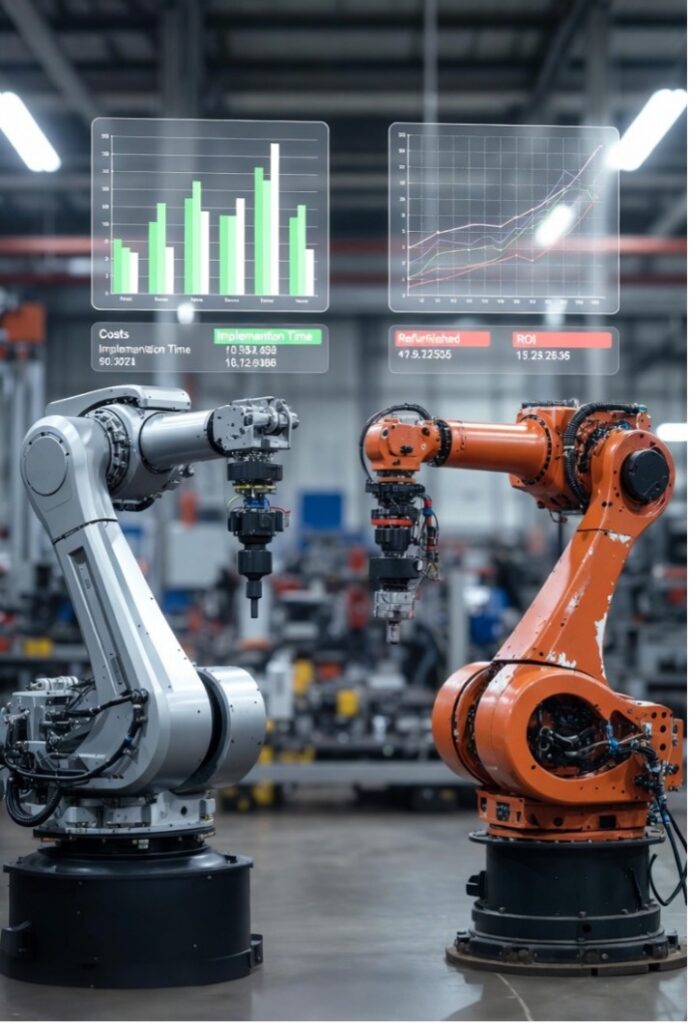
Refurbished vs New Industrial Robots: ROI Comparison
When companies plan industrial automation projects, one key question consistently drives the decision-making process: how quickly will the investment pay for itself? Return on investment (ROI) is often more critical than raw performance or technology novelty. While new industrial robots offer the most recent hardware and software innovations, refurbished industrial robots—professionally restored and tested to operate like new—have become a strategic alternative for manufacturers seeking faster payback and controlled capital expenditure.
This article provides a technical and economic comparison between refurbished and new industrial robots, focusing on ROI-relevant variables such as initial investment, total cost of ownership, deployment speed, depreciation, reliability, and application suitability. The goal is not to promote one option universally, but to support data-driven decisions aligned with business objectives.
Why ROI Matters More Than Ever in Industrial Automation
Industrial automation is no longer only about increasing throughput. In today’s manufacturing environment, ROI must account for:
Capital expenditure constraints
Workforce availability and costs
Production flexibility requirements
Risk exposure and operational continuity
A robot that is technically superior but underutilized may generate a slower ROI than a simpler, lower-cost system perfectly matched to the application. This is where the refurbished versus new robot comparison becomes especially relevant.
Initial Investment and Total Cost of Ownership (TCO)
New Industrial Robots
New industrial robots generally involve a higher upfront investment. This cost reflects:
Latest-generation hardware and controllers
Full manufacturer warranty
Long-term software roadmap
Compatibility with the newest peripherals
However, these advantages do not automatically translate into higher efficiency. If an application does not require advanced features such as AI-driven path planning or high-resolution vision integration, part of the investment may remain unused.
Refurbished Industrial Robots
Refurbished robots are previously used units that have been disassembled, inspected, restored, and tested to meet defined operational standards. When properly refurbished, these robots deliver reliable performance at up to 40–60% lower acquisition cost compared to comparable new models.
This price difference allows companies with limited automation budgets to:
Accelerate automation roadmaps
Deploy multiple robots instead of one
Reduce financial exposure per cell
From a TCO perspective, a lower initial investment often has a direct and positive impact on ROI calculations.
Deployment Time and Speed to Value
Time-to-Production as an ROI Driver
The faster a robot generates productive output, the faster it contributes to ROI. Deployment timelines depend on availability, configuration, and integration complexity.
New Robots: Longer Lead Times
New robots frequently involve:
Manufacturing lead times
Custom configuration and testing
Shipping delays
Extended commissioning phases
In some cases, these factors can delay production start by several months, postponing ROI realization.
Refurbished Robots: Faster Integration
Refurbished robots are often available from stock, allowing integrators and manufacturers to:
Begin system integration sooner
Reduce commissioning time
Launch production earlier
For standard applications, this faster deployment can significantly shorten the time required to recover the initial investment.
ROI Explained: Key Financial Drivers
ROI compares net operational benefits against total investment. In robot selection, three dimensions strongly influence the result.
Cost Versus Benefit Balance
A refurbished robot’s lower purchase price can yield faster ROI, even if its specifications are slightly below those of the latest model. In many real-world scenarios, productivity and cost savings compensate for the absence of cutting-edge features.
Depreciation Profiles
New robots tend to depreciate rapidly, particularly when newer generations are released. Refurbished robots already reflect market-adjusted value, resulting in slower and more predictable depreciation.
Payback Period
Thanks to reduced capital cost and faster deployment, refurbished robots often achieve payback in shorter timeframes—especially in applications that do not require advanced sensing or AI capabilities.
Reliability and Productivity Considerations
Are Refurbished Robots Reliable?
A common concern is whether refurbished robots can match the reliability of new units. When refurbishment follows a structured process—including precision testing, component replacement, and lifecycle validation—performance can be comparable to new equipment.
New Robots: When Technology Matters
For applications involving:
Advanced machine vision
AI-based decision logic
High-speed collaborative operation
new robots may offer a technical advantage. However, for standard tasks such as material handling, palletizing, welding, assembly, or machine tending, refurbished robots are highly competitive.
Application Suitability: Choosing the Right Tool
The best robot is not always the newest—it is the one that best fits the task.
Typical Applications for Refurbished Robots
Pick and place
Palletizing and depalletizing
Arc and spot welding
CNC machine tending
Basic assembly operations
Applications Favoring New Robots
Vision-intensive inspection
Human-robot collaboration with advanced safety
Rapid multi-product changeovers with AI optimization
Strategic Perspective: Flexibility and Risk Management
Refurbished robots offer an opportunity to spread automation risk. Instead of committing large capital to a single system, companies can test automation concepts, scale gradually, and preserve financial flexibility.
This approach is particularly relevant for:
Small and medium-sized manufacturers
Companies automating for the first time
Plants with uncertain demand forecasts
The Role of the Integrator and Supplier
The success of refurbished or new robots depends heavily on how the solution is engineered and supported.
URC focuses on matching robot selection to process requirements, lifecycle expectations, and financial targets, ensuring that both refurbished and new robots deliver measurable results rather than theoretical performance.
Frequently Asked Questions (FAQ)
Do refurbished robots perform like new ones?
Yes, when restored and tested by qualified specialists, refurbished robots can deliver comparable operational performance.
Are refurbished robots cheaper to maintain?
Maintenance depends more on usage and duty cycle than on whether a robot is new or refurbished. However, lower purchase cost often results in a reduced total cost of ownership.
What factors most influence ROI?
Initial investment, deployment time, productivity gains, operational life, and maintenance costs.
ROI Evaluation Checklist
Compare initial cost between new and refurbished robots
Analyze deployment and commissioning time
Match robot capabilities to process requirements
Estimate payback period in months or years
Include long-term maintenance and energy costs
Verify spare parts availability and technical support
External Sources and References
International Federation of Robotics (IFR) – World Robotics Reports
https://ifr.org
ISO 10218 – Safety of Industrial Robots
https://www.iso.org
McKinsey & Company – Automation and Capital Productivity
https://www.mckinsey.com
Internal Links (Suggested)
Refurbished Industrial Robots
Industrial Robot Integration Services
ROI Analysis for Automation Projects
Call to Action (CTA)
URC supports manufacturers in evaluating and deploying both refurbished and new industrial robots based on real ROI, process requirements, and long-term sustainability. From feasibility analysis to system integration, URC helps organizations make automation investments that deliver measurable value.
If your company is considering automation or evaluating whether refurbished or new robots are the best choice, URC can help you identify the most effective solution for your operational and financial objectives.
Refurbished vs New Industrial Robots: ROI Comparison Read More »


