Search
Close this search box.
Used Robots Logo
admin, Author at Used Robots

Author name: admin

HOW TO REDUCE MICRO‑ERRORS WHEN HANDLING SENSITIVE COMPONENTS WITH INDUSTRIAL ROBOTS

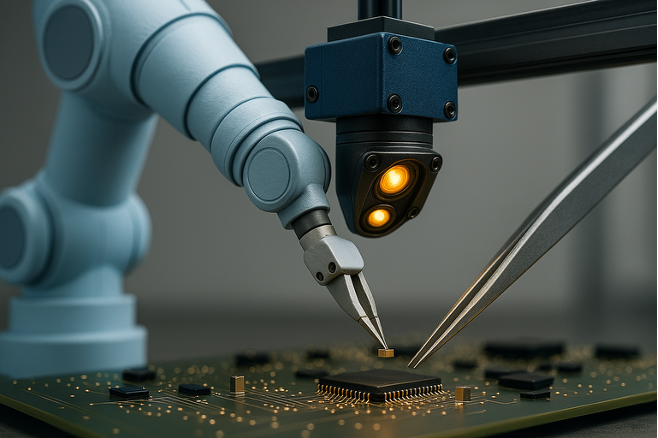
Installing a higher‑precision robot alone does not automatically eliminate micro‑errors in robotic handling — although it can significantly reduce them.
In fine assembly, medical devices, electronics, and fragile components, results depend on a combination of factors:

position validation
gripping strategy
overall process stability
part presentation

When these elements are designed together, the robotic cell becomes more reliable and prevents small faults that can later turn into significant economic losses.

What micro‑errors are — and why they are so costly
Micro‑errors are small deviations that do not always stop the production line but compromise quality and repeatability.
Typical examples include:

slightly misoriented parts
excessive gripping force
minor misalignment before assembly
part release outside tolerance

In high‑value industries, these issues lead to:

scrap
rework
latent defects that are difficult to detect immediately

Their danger lies in the fact that they appear insignificant — until they accumulate.
For this reason, nominal robot precision alone is not a sufficient selection criterion.
Even a highly repeatable robot can generate errors if:

parts arrive incorrectly positioned
the gripper distributes force unevenly
the system does not confirm that the component is actually in the correct position

This is a system‑level challenge, not a single specification issue.

Where micro‑errors most commonly originate
In many projects, the problem starts before the robot touches the part.
Common sources include:

poorly designed feeders, trays, or carriers
unstable part positioning
inconsistent incoming orientation

Another frequent cause is the end‑effector design:

contact surfaces not properly sized
materials that mark or damage the part
gripping solutions that cannot tolerate small batch variations

When components are sensitive, oversimplification becomes expensive.
Validation strategy also plays a key role.
If the cell does not verify:

presence
orientation
correct seating

after handling, micro‑errors propagate downstream.
Adding vision, sensors, or simple validation checks at the right points is often more cost‑effective than trying to correct issues only through increasingly precise robot paths.

Solutions that improve reliability
The most robust robotic cells combine:

gripper design tailored to the real part
stable part presentation
minimal but effective validation

In some cases, a small change to the gripper’s contact surface or the addition of a mechanical reference can eliminate a significant error rate.
In other applications, machine vision provides the fine correction needed to absorb variation without reducing throughput.
This topic naturally connects with EUROBOTS part assembly solutions, especially when precision must be applied in practice rather than promised by generic specifications.
The key message is clear:
reducing micro‑errors is not about achieving absolute perfection, but about designing a cell that detects, compensates for, and limits variation before it affects the product.

How to measure improvement and justify changes
Final reject rate is not always the best indicator.
It is also useful to track:

errors detected in‑line
automatic corrections performed
operator interventions
stability of the gripping reference

These metrics show whether the cell operates with margin or relies too heavily on continuous adjustments.
To justify improvements, it helps to quantify the real cost of each micro‑error:

damaged parts
diagnostic time
rework
downstream blockages
loss of customer confidence

Once this impact is visible, relatively small investments in gripping, vision, or tooling are seen not as optional extras, but as quality protection measures.

❓ FAQ
Is machine vision always required?
No. Vision is extremely useful when part position or orientation varies, but in some cases well‑designed tooling and simple validations solve the problem without adding unnecessary complexity.
What usually fails first: the robot or the gripper?
In sensitive applications, the gripper and part presentation often have a greater impact than the robot itself. Poor gripping design can generate errors even with a highly precise arm.
How can I tell if I have a micro‑error problem?
Look for intermittent rejects, unexplained rework, frequent manual corrections, and small deviations that appear more often in specific batches or shifts.

✅ If micro‑errors are silently affecting your quality or costs,
👉 let’s analyze your handling process together and design a robotic solution that prevents small deviations from becoming big problems.

HOW TO REDUCE MICRO‑ERRORS WHEN HANDLING SENSITIVE COMPONENTS WITH INDUSTRIAL ROBOTS Read More »

HOW TO INTEGRATE ROBOTS INTO CLEANROOMS WITHOUT COMPROMISING PROCESS VALIDATION

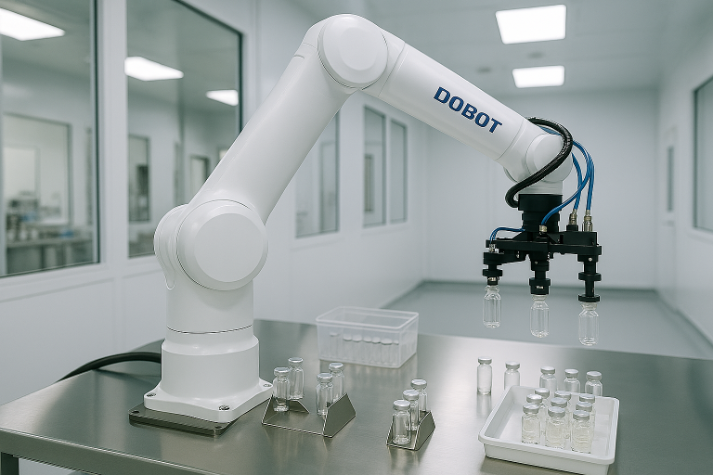
Yes, industrial robots can be integrated into cleanrooms without compromising validation — but the project must be treated as a quality decision, not just an automation upgrade. This means ensuring that the robot, tooling, materials, cleaning procedures, documentation, and control logic all meet the requirements of the regulated process. When done properly, robotics helps reduce manual intervention, stabilize critical tasks, and reinforce repeatability without weakening the controlled environment.

Cleanroom automation requires thinking beyond the robot
In pharmaceuticals, medical devices, advanced cosmetics, and laboratory environments, the biggest initial risk is not programming — it’s introducing a contamination source or an unvalidated variable.
For this reason, selecting a cleanroom‑compatible robot must be evaluated together with:

the design of the cell
contact materials
lubricants
protective covers
suction or extraction systems (if required)
and cleaning procedures between batches

A technically brilliant solution can become unfeasible if it complicates sanitation, release activities, or documentation.
This also changes how project success is defined.
In a regulated process, it is not enough for the robot to “run” and maintain throughput.
It must prove that it operates consistently, that critical parameters are controlled, and that operator intervention is limited and well‑defined.
This requires early thinking around equipment states, permissions, recipes, event logs, and acceptance criteria for each validation phase.

What to review before approving integration
The first analysis should focus on environmental compatibility and cleanability.
Exposed surfaces, particle accumulation points, wiring, and accessories must be evaluated with the same rigor as any other process component.
Then comes documentation:

functional specifications
risk assessment
change traceability
testing plans
qualification evidence

The earlier quality and validation teams participate, the fewer reworks appear during commissioning.
Another critical point is the interface between robot and process.
If the cell handles containers, dispenses, assembles, or inspects, you must define exactly:

which data must be recorded
which deviation triggers an alarm
when the system must stop

In regulated environments, automation creates value when it transforms variable manual tasks into repeatable, auditable sequences.
To achieve this, the system must be designed to generate meaningful evidence — not just to move parts.

Where robotics usually adds the most value
Robotics fits extremely well in repetitive tasks where human intervention adds risk or variability:

loading and unloading
tray and component handling
equipment feeding
sensitive assemblies
vision‑based inspection

Here, the benefit isn’t only speed — it’s reduced contact, stable sequences, and consistent quality over long periods without fatigue or improvisation.
From an editorial perspective, this topic naturally connects to EUROBOTS industrial robotic system applications, especially for readers comparing cell types or evaluating which application families transfer best to controlled environments. The tone should be consultative: less generic promise, more clarity on requirements, limits, and documentation.

Common mistakes and best practices for smooth validation
The most common mistake is leaving validation for the end — as if it were a simple documentation layer added once everything works.
In reality, if the design does not include cleaning, access, interlocks, alarm handling, and event logging, validation becomes slow and expensive.
Another issue is underestimating operator training: even a highly capable system can generate deviations if users are unclear about parameter changes, escalation paths, and stop criteria.
The best practice is to build the project around process control requirements.
This means translating production goals into verifiable limits:

timing
positions
part acceptance rules
safe states
change traceability

Once the robot fits into this framework, it stops feeling like a black box and becomes a validatable component of the system.
That shift in mindset is what truly enables adoption in regulated environments.

FAQ
Are all robots suitable for a cleanroom?
No. Materials, lubrication, exposed surfaces, cleanability, and suitability for the required cleanliness level must be evaluated. Compatibility depends on both the robot and the complete cell.
Is validation only about checking that the robot repeats well?
No. It also covers process control, change management, logs, alarms, access control, cleaning, and documented evidence. Repeatability is important — but not sufficient.
What advantages does robotics offer compared to manual work?
Reduced direct contact, higher repeatability, better process control, and lower variability in critical tasks. In cleanrooms, these benefits are often as important as productivity.

HOW TO INTEGRATE ROBOTS INTO CLEANROOMS WITHOUT COMPROMISING PROCESS VALIDATION Read More »

WHAT STRATEGIES EXIST TO MINIMIZE DOWNTIME WHEN INTRODUCING ROBOTIC AUTOMATION INTO CONTINUOUS PROCESSES?

When robots become an essential part of operational workflows, unplanned downtime can become one of the most significant sources of productivity loss in automated plants.
System errors, unexpected stoppages, and urgent repairs can delay deliveries and create costly disruptions that negatively affect competitiveness.
Implementing strategies that minimize these downtime events and maximize the operational availability of your robotic systems is crucial.
In this article, we outline the most effective, technically validated practices that help ensure your automation runs continuously and reliably.
👉 Complementary real article from Eurobots on industrial robot maintenance and operation:
HOW TO KEEP AN INDUSTRIAL ROBOT IN OPTIMAL CONDITION
1. Implement a Preventive Maintenance Program
A well‑structured preventive maintenance plan allows you to inspect, calibrate, and replace components before they fail.
Industrial studies show that preventive maintenance can:
Reduce unexpected downtime by 50–75%
Extend the service life of critical components
Lower the costs associated with unplanned repairs
This includes routine checks of lubrication, sensors, motors, and control systems according to the manufacturer’s recommendations and the robot’s actual operational usage.
2. Integrate Data‑Driven Predictive Maintenance
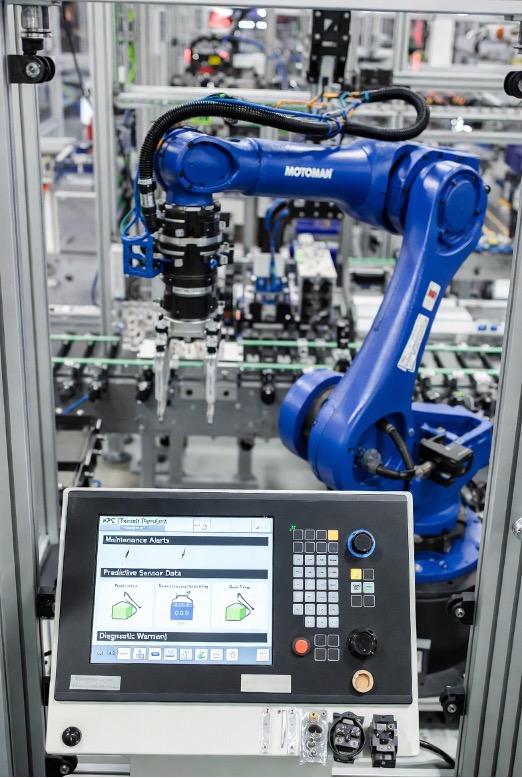
Unlike preventive maintenance (based on time or usage intervals), predictive maintenance uses real‑time data from sensors and equipment status to anticipate failures before they occur.
Technical sources highlight that this approach enables:
Maintenance performed right before it becomes necessary
Turning unexpected stops into planned interventions
Optimizing plant availability in real time
Industrial IoT technologies and data analytics allow detection of degradation trends and help plan service actions without interrupting production.
3. Continuous Training for Technical Staff and Operators
Human expertise remains a key element. A well‑trained team can:
Detect early signs of failure before they escalate into stoppages
Respond quickly to system alarms
Perform basic preventive maintenance without external technicians
Technical training should include fault diagnosis, robot parameter updates, and sensor signal analysis.
4. Spare Parts Management and Internal Logistics
Many prolonged downtime events are caused by the lack of critical spare parts or delays in repair logistics.
An effective strategy includes:
Proper stock of high‑wear components
Classification of spare parts by criticality
Optimized replacement procedures
URC recommends maintaining a minimum inventory of consumables and components with the highest operational wear.
5. Using Integrated Diagnostics and Monitoring Systems
Modern robotic systems include diagnostic tools that:
Monitor operating conditions
Log errors and significant events
Send alerts before major failures
This type of monitoring allows plant managers to anticipate trends and schedule maintenance ahead of time.

6. Designing Systems with Operational Redundancy
In critical applications, redundancy may include:

Backup robots or duplicated modules
Automatic switching systems
Alternative paths within production flows

While this requires a higher initial investment, it significantly reduces the impact of failures in single system elements.

❓ FAQs
What causes most downtime in robotic automation?
The most common causes include mechanical failures, software errors, lack of maintenance, and unavailable spare parts.
How impactful can well‑implemented predictive maintenance be?
It can convert most unexpected stoppages into planned downtime, increasing system availability and reducing total maintenance costs.
Is it expensive to implement these strategies?
Smart maintenance investments are often quickly offset by reduced downtime, longer equipment lifespan, and significantly improved overall productivity.

Checklist to Minimize Downtime
☐ Implement a preventive maintenance plan
☐ Integrate predictive maintenance with data analytics
☐ Train technical staff and operators
☐ Ensure inventory of critical spare parts
☐ Connect diagnostic and monitoring systems
☐ Evaluate operational redundancy for critical processes

WHAT STRATEGIES EXIST TO MINIMIZE DOWNTIME WHEN INTRODUCING ROBOTIC AUTOMATION INTO CONTINUOUS PROCESSES? Read More »

When Does It Make Sense to Automate Only Part of the Process?

For years, automation was framed as an absolute goal:
either everything was automated, or nothing was.
In real industrial environments, that logic rarely works. Processes are more complex—and often more efficient—when not forced into an all‑or‑nothing decision.
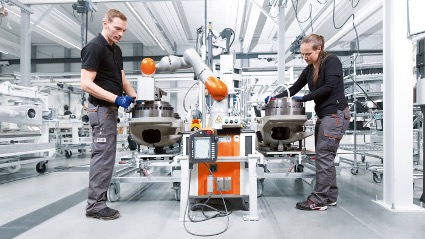
Partial automation is not a compromise. It is a strategic choice.
One that requires understanding where robots create stability and where humans add irreplaceable value.
The real question isn’t “Can we automate everything?” but rather:
“Should we?”

Why Partial Automation Makes Sense
Some tasks benefit massively from robotic precision—repetitive movements, heavy lifting, defined trajectories, sustained physical strain.
Other tasks rely on human capabilities—variability handling, contextual judgment, rapid adaptation.
Forcing robots to replace both often results in:

Over‑engineered systems
Rigid processes
High reprogramming costs
Reduced productivity over time

The most successful automation projects strike a balance:
robotic repeatability + human flexibility.

Problems Caused by Over‑Automation

The system becomes heavy and difficult to maintain
Every new variation requires reprogramming
Exceptions become disruptions rather than manageable events
Operators feel disconnected from the system
Productivity may decrease instead of improving

Automation should adapt to the process—not force the process to adapt to the automation.

When Partial Automation Is Technically the Best Option
Partial automation is ideal when a process contains both:
1. High‑repeatability segments

Repetitive motions
Physically demanding operations
Precise and stable trajectories
Tasks requiring constant accuracy

2. High‑variability segments

Situations requiring human decision‑making
Context‑dependent adjustments
Handling of unpredictable elements
Quality checks requiring interpretation

In these hybrid systems, interface design is crucial—both physical and digital. Operators and robots must transition seamlessly between roles without friction or risk.

The Human Factor: The Most Overlooked Part of Automation
Partial automation acknowledges that human value does not disappear—it shifts.
Operators evolve from executors to:

Supervisors
Adjusters
Process interpreters

When this transition isn’t supported, systems fail for human—not technical—reasons.
A robot may work perfectly, but the team doesn’t trust it, doesn’t understand it, or feels displaced by it.
Projects that succeed:

Do not aim to replace people
Redistribute intelligence between humans and machines
Preserve a visible, meaningful human role

This clarity increases adoption and reduces resistance.

The Paradox: More Flexibility Through Less Automation
The most flexible systems are often those that didn’t attempt full automation.
Leaving deliberate room for human intervention gives:

Faster adaptation to product or process changes
Reduced need to redesign the entire cell
More resilience and robustness over time

Partial automation is not “halfway.”
It is strategic efficiency—not extremism.
Key Principles
Benefits of Partial Automation

Balances robot stability with human adaptability
Reduces system rigidity
Lowers long‑term programming costs
Helps handle variability and exceptions smoothly
Increases team acceptance and engagement

Risks of Full Automation

Over‑complexity
Higher maintenance and reprogramming needs
Reduced flexibility
Lower resilience to real‑world variability
Human–machine mistrust

Ideal Conditions for Partial Automation

Mixed repeatability and variability
Processes requiring both precision and judgment
Situations where human adaptation adds value
Systems with frequent product changes

Checklist: Should You Automate Everything or Only Part of It?
Evaluate repeatability

Are parts of the process strictly repetitive?
Do these steps require consistent precision?
Do they involve physical strain or risk?

Evaluate variability

Are there steps requiring human judgment?
Do operators frequently adjust parameters or conditions?
Are there elements that cannot be predicted?

Evaluate system flexibility

Will the process evolve over time?
Would full automation make updates slow or costly?
Do operators need to intervene regularly?

Evaluate human–machine collaboration

Does the team understand the system?
Will people still have a meaningful role?
Is there a risk of resistance or loss of trust?

If many boxes are checked, partial automation is likely the best strategy.

FAQ — Partial Automation in Industrial Processes
Is partial automation a sign of project failure?
No. It is a strategic decision used in the most efficient production environments.
Why not automate everything if the technology exists?
Because many tasks require adaptability and judgment that robots cannot replicate efficiently.
Does partial automation reduce ROI?
Often the opposite: it reduces costs, increases flexibility, and shortens update times.
Can partial automation improve worker satisfaction?
Yes. Workers shift to higher‑value tasks, reducing fatigue and increasing engagement.
Does partial automation make the system more complex?
No—full automation is usually more complex. Hybrid systems offer better balance and maintainability.

Final Thought
Partial automation is not about doing less. It’s about doing what works best.
The most efficient systems are those that know exactly where to stop automating.

When Does It Make Sense to Automate Only Part of the Process? Read More »

INDUSTRIAL ROBOTICS TRENDS FOR 2026: INTELLIGENCE, MOBILITY & SUSTAINABILITY

Industrial robotics is entering a new era. Robots are no longer just programmable arms repeating tasks—they are becoming connected, mobile, intelligent, and increasingly aligned with sustainability goals. According to the latest report from the International Federation of Robotics (IFR), global demand for industrial robots reached 542,000 installed units in 2024, more than double compared to

INDUSTRIAL ROBOTICS TRENDS FOR 2026: INTELLIGENCE, MOBILITY & SUSTAINABILITY Read More »

WHAT ROLE DOES ERGONOMICS PLAY WHEN TRANSITIONING FROM A MANUAL PROCESS TO A ROBOTIC ONE?

Ergonomics is not about comfort — it is industrial survival. In daily plant operations, behind every welded, sanded, polished, lifted, or manually handled part, there is an invisible truth: the human body absorbs tension, weight, heat, vibration, repetition, and risk. Ergonomics is not a corporate luxury; it is a technical requirement and the science that

WHAT ROLE DOES ERGONOMICS PLAY WHEN TRANSITIONING FROM A MANUAL PROCESS TO A ROBOTIC ONE? Read More »

HOW LONG DOES IT REALLY TAKE TO COMMISSION A ROBOTIC CELL?

When discussing automation, one question inevitably arises: “How long will the line be down?” This is not a matter of technical curiosity—it’s a reflection of real pressure. Production is at stake, customers are waiting, shifts are scheduled, and people are watching the calendar. Commissioning is not just another project phase; it is a critical moment

HOW LONG DOES IT REALLY TAKE TO COMMISSION A ROBOTIC CELL? Read More »

High-Impact Applications That Work Perfectly with Refurbished Robots

The Global Trend Toward Accessible Automation The industry is undergoing an interesting shift: many companies are automating processes using refurbished industrial robots because they deliver the same level of functionality for a wide range of applications—especially in cases where cutting-edge technology is not essential. This trend is evident in sectors such as automotive, metalworking, plastics,

High-Impact Applications That Work Perfectly with Refurbished Robots Read More »

CAN ROBOTIC SOLUTIONS WITH REFURBISHED ROBOTS BE ADAPTED TO EXISTING SYSTEMS IN AN INDUSTRIAL WELDING PLANT?

In many plants, welding doesn’t start from scratch: there are already tables, positioners, welding power sources, tooling, extraction systems and, in some cases, software or manual stations that have been in place for years. It’s only natural to wonder: can a refurbished robot be integrated into that environment without having to replace everything? The industrial

CAN ROBOTIC SOLUTIONS WITH REFURBISHED ROBOTS BE ADAPTED TO EXISTING SYSTEMS IN AN INDUSTRIAL WELDING PLANT? Read More »

UPDATE AND MODERNISATION OF INDUSTRIAL ROBOTS: WHEN IS IT BETTER TO REFURBISH RATHER THAN BUY NEW?

In many workshops, the dilemma arises over whether to purchase a new robot or upgrade the one already installed. Thanks to advancements in controllers, sensors, software, and mechatronics, older components can be brought back to life effectively. The key is knowing when refurbishment makes sense and when it’s time to invest in new equipment. Why

UPDATE AND MODERNISATION OF INDUSTRIAL ROBOTS: WHEN IS IT BETTER TO REFURBISH RATHER THAN BUY NEW? Read More »

Scroll to Top