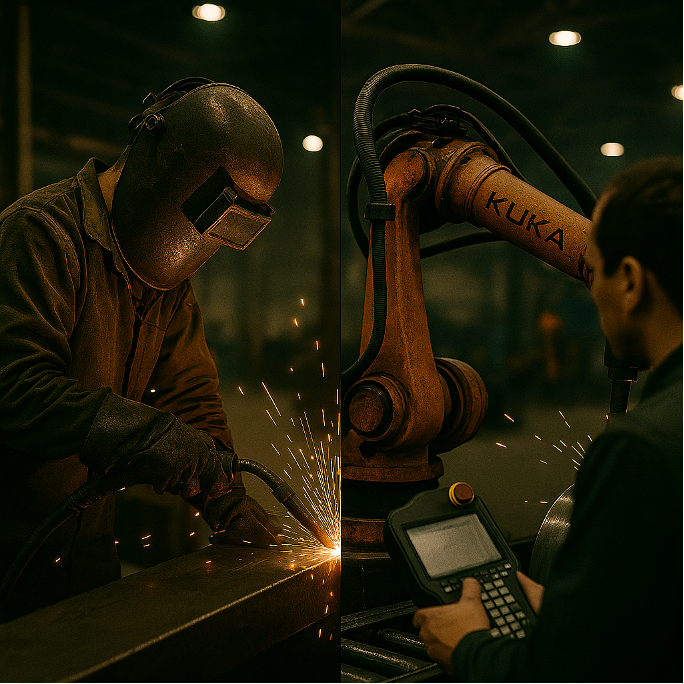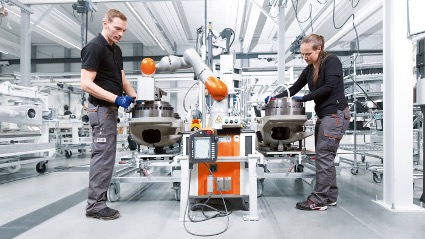
When Does It Make Sense to Automate Only Part of the Process?
For years, automation was framed as an absolute goal:
either everything was automated, or nothing was.
In real industrial environments, that logic rarely works. Processes are more complex—and often more efficient—when not forced into an all‑or‑nothing decision.
Partial automation is not a compromise. It is a strategic choice.
One that requires understanding where robots create stability and where humans add irreplaceable value.
The real question isn’t “Can we automate everything?” but rather:
“Should we?”
Why Partial Automation Makes Sense
Some tasks benefit massively from robotic precision—repetitive movements, heavy lifting, defined trajectories, sustained physical strain.
Other tasks rely on human capabilities—variability handling, contextual judgment, rapid adaptation.
Forcing robots to replace both often results in:
Over‑engineered systems
Rigid processes
High reprogramming costs
Reduced productivity over time
The most successful automation projects strike a balance:
robotic repeatability + human flexibility.
Problems Caused by Over‑Automation
The system becomes heavy and difficult to maintain
Every new variation requires reprogramming
Exceptions become disruptions rather than manageable events
Operators feel disconnected from the system
Productivity may decrease instead of improving
Automation should adapt to the process—not force the process to adapt to the automation.
When Partial Automation Is Technically the Best Option
Partial automation is ideal when a process contains both:
1. High‑repeatability segments
Repetitive motions
Physically demanding operations
Precise and stable trajectories
Tasks requiring constant accuracy
2. High‑variability segments
Situations requiring human decision‑making
Context‑dependent adjustments
Handling of unpredictable elements
Quality checks requiring interpretation
In these hybrid systems, interface design is crucial—both physical and digital. Operators and robots must transition seamlessly between roles without friction or risk.
The Human Factor: The Most Overlooked Part of Automation
Partial automation acknowledges that human value does not disappear—it shifts.
Operators evolve from executors to:
Supervisors
Adjusters
Process interpreters
When this transition isn’t supported, systems fail for human—not technical—reasons.
A robot may work perfectly, but the team doesn’t trust it, doesn’t understand it, or feels displaced by it.
Projects that succeed:
Do not aim to replace people
Redistribute intelligence between humans and machines
Preserve a visible, meaningful human role
This clarity increases adoption and reduces resistance.
The Paradox: More Flexibility Through Less Automation
The most flexible systems are often those that didn’t attempt full automation.
Leaving deliberate room for human intervention gives:
Faster adaptation to product or process changes
Reduced need to redesign the entire cell
More resilience and robustness over time
Partial automation is not “halfway.”
It is strategic efficiency—not extremism.
Key Principles
Benefits of Partial Automation
Balances robot stability with human adaptability
Reduces system rigidity
Lowers long‑term programming costs
Helps handle variability and exceptions smoothly
Increases team acceptance and engagement
Risks of Full Automation
Over‑complexity
Higher maintenance and reprogramming needs
Reduced flexibility
Lower resilience to real‑world variability
Human–machine mistrust
Ideal Conditions for Partial Automation
Mixed repeatability and variability
Processes requiring both precision and judgment
Situations where human adaptation adds value
Systems with frequent product changes
Checklist: Should You Automate Everything or Only Part of It?
Evaluate repeatability
Are parts of the process strictly repetitive?
Do these steps require consistent precision?
Do they involve physical strain or risk?
Evaluate variability
Are there steps requiring human judgment?
Do operators frequently adjust parameters or conditions?
Are there elements that cannot be predicted?
Evaluate system flexibility
Will the process evolve over time?
Would full automation make updates slow or costly?
Do operators need to intervene regularly?
Evaluate human–machine collaboration
Does the team understand the system?
Will people still have a meaningful role?
Is there a risk of resistance or loss of trust?
If many boxes are checked, partial automation is likely the best strategy.
FAQ — Partial Automation in Industrial Processes
Is partial automation a sign of project failure?
No. It is a strategic decision used in the most efficient production environments.
Why not automate everything if the technology exists?
Because many tasks require adaptability and judgment that robots cannot replicate efficiently.
Does partial automation reduce ROI?
Often the opposite: it reduces costs, increases flexibility, and shortens update times.
Can partial automation improve worker satisfaction?
Yes. Workers shift to higher‑value tasks, reducing fatigue and increasing engagement.
Does partial automation make the system more complex?
No—full automation is usually more complex. Hybrid systems offer better balance and maintainability.
Final Thought
Partial automation is not about doing less. It’s about doing what works best.
The most efficient systems are those that know exactly where to stop automating.
When Does It Make Sense to Automate Only Part of the Process? Read More »